


There are landscapes that look beautiful in photographs, and then there are places that feel unreal even when you’re standing inside them. The Salar de Uyuni belongs firmly in the second category. Known as the world’s largest salt flat, it transforms during certain times of the year into something that feels almost impossible: a perfectly reflective surface that turns the sky into an endless mirror.
Located in southwest Bolivia, the Salar de Uyuni stretches across more than 10,000 square kilometers. It is vast, blindingly white in the dry season, and astonishingly reflective in the wet season. Travelers often arrive expecting a scenic viewpoint. They leave feeling like they stepped into another dimension.
If you have ever seen photos of people walking on clouds or standing inside a perfectly symmetrical horizon where sky and earth dissolve into one, you were probably looking at the Salar de Uyuni.
What Makes the Salar de Uyuni So Unique
At first glance, a salt flat may not sound extraordinary. However, the scale of the Salar de Uyuni is what makes it so mesmerizing. It is the largest salt flat on Earth, formed by the transformation of prehistoric lakes thousands of years ago. What remains today is a thick crust of salt stretching farther than the eye can see.
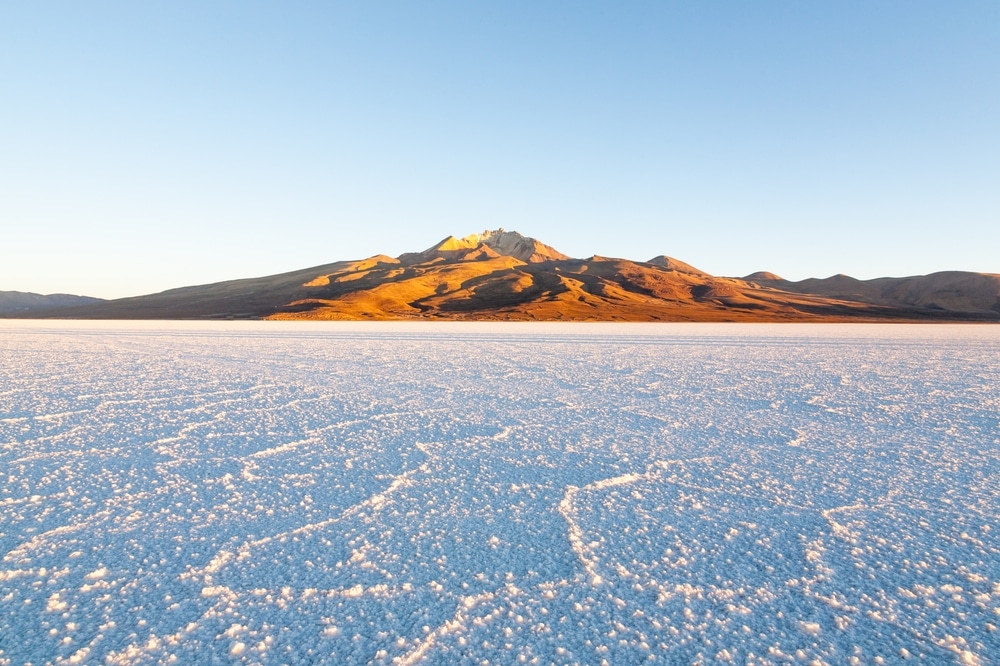
During the dry season, the surface hardens into a geometric pattern of salt polygons. These hexagonal formations create a surreal natural mosaic, sharp and bright under the Andean sun. The landscape feels infinite, with distant mountains floating on the horizon.
During the rainy season, usually between January and March, a thin layer of water covers the surface. This is when the Salar de Uyuni earns its reputation as the world’s largest mirror. The water creates a flawless reflection of the sky, making it nearly impossible to distinguish where land ends and sky begins. Clouds appear beneath your feet. Sunsets double in intensity. Photographs barely capture the scale of the experience.
Getting to the Salar de Uyuni
Reaching the Salar de Uyuni requires a bit of effort, which only adds to its mystique. Most travelers begin their journey in the small town of Uyuni. The town itself is modest, with dusty streets and simple accommodations, but it serves as the gateway to one of the most surreal landscapes on the planet.
You can arrive in Uyuni by overnight bus from La Paz or by domestic flight. Many travelers combine a visit to the Salar de Uyuni with a multi-day tour that explores the surrounding high-altitude desert, lagoons, and geothermal areas near the Chilean border.
The remoteness of the region contributes to its otherworldly atmosphere. Once you leave Uyuni town in a four-wheel-drive vehicle, civilization quickly fades. The road becomes flat and white, and soon you are driving across what feels like an endless frozen ocean.
Walking on the World’s Largest Mirror
Stepping out onto the Salar de Uyuni for the first time can feel disorienting. In the dry season, the brightness is intense. Sunglasses are not optional. The horizon stretches uninterrupted in every direction, creating a sense of vast openness that can feel both peaceful and overwhelming.
In the wet season, the experience becomes even more surreal. The shallow water creates a mirror so perfect that the landscape appears symmetrical. When you walk across the surface, your reflection follows you precisely. At sunrise and sunset, the sky explodes with color, and the reflection doubles the spectacle.
Many visitors describe the sensation as walking inside the sky. The lack of visual boundaries plays tricks on your perception. Distances become difficult to judge. The world feels larger and quieter than usual.
The Salar de Uyunini does not just look different. It feels different. Sound seems to carry differently in such an open space. Wind moves across the flat surface without obstruction. The silence can feel profound.
Photography and Perspective
One of the reasons the Salar de Uyuni became globally famous is its potential for perspective photography. Because the horizon is uninterrupted and the surface is so flat, photographers can create optical illusions that distort scale. People appear to balance on toy dinosaurs or emerge from tiny coffee cups.
However, beyond playful perspective shots, the true magic lies in capturing the mirror effect during the rainy season. Reflections create symmetrical compositions that look digitally manipulated but are completely natural.
The key to photographing the Salar de Uyuni is patience. Light changes quickly at high altitude. Sunrise and sunset provide the most dramatic reflections. Even amateur photographers can capture extraordinary images simply because the environment is so visually powerful.
Isla Incahuasi and the Cactus Island
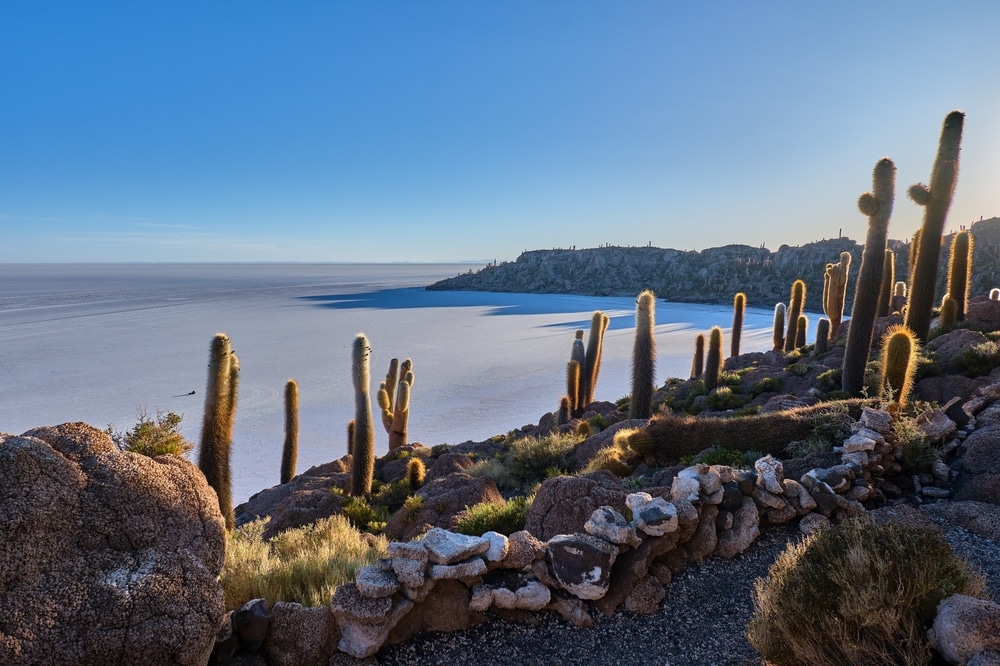
In the middle of the Salar de Uyuni sits Isla Incahuasi, often referred to as Cactus Island. This rocky outcrop rises dramatically from the flat white surface, covered in towering cacti that can reach several meters in height.
Climbing to the top of Isla Incahuasi offers a panoramic view of the surrounding salt flat. From this vantage point, the scale becomes more tangible. The white expanse stretches endlessly in every direction, framed by distant Andean peaks.
The island provides a striking contrast to the surrounding flatness. The combination of salt crust, ancient coral formations, and towering cacti feels almost extraterrestrial. It is one of the most memorable stops on any tour of the Salar de Uyuni.
The High-Altitude Desert Beyond the Salt Flats
Many tours extend beyond the Salar de Uyuni into Bolivia’s high-altitude desert landscapes. These areas include colorful lagoons filled with flamingos, volcanic backdrops, and geothermal fields with steaming vents.
The surrounding region feels like a different planet. Red and green lagoons contrast sharply with the white salt flats. Flamingos gather in shallow waters against a backdrop of snow-capped peaks. Geysers release bursts of steam into the cold morning air.
Visiting the Salar de Uyuni as part of a multi-day tour deepens the experience. It reveals how diverse and dramatic Bolivia’s southwestern region truly is.
Best Time to Visit the Salar de Uyuni
Choosing when to visit depends on what you want to experience. The dry season, typically from May to November, offers clear skies and stable driving conditions. The salt crust is firm, and access is straightforward. The geometric patterns on the ground are especially visible during this period.
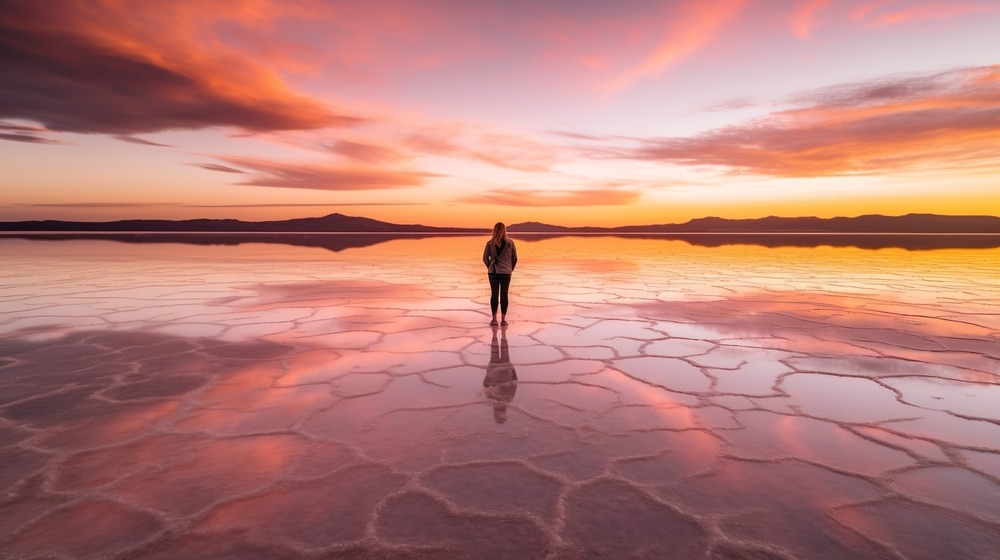
The rainy season, generally from January to March, creates the mirror effect that made the Salar de Uyuni famous. However, heavy rainfall can sometimes limit access to certain areas.
For many travelers, the ideal time falls during the transition months when there is enough water for reflection but not so much that roads become impassable. Each season offers a distinct visual experience, and both are remarkable in their own way.
The Science Behind the Salt Flat
The Salar de Uyuni is not just visually impressive; it is geologically significant. It contains one of the largest lithium reserves in the world, making it important for modern battery production. Beneath the thick salt crust lies brine rich in lithium and other minerals.
The salt crust itself can be several meters thick in some areas. It is strong enough to support vehicles, which is why tours can drive across it. The extreme flatness of the Salar de Uyuni has even made it useful for calibrating satellite instruments.
This blend of natural beauty and scientific importance adds another layer to the experience. You are not just visiting a scenic site; you are standing on a landscape that plays a role in global technology and environmental discussions.
Altitude and Travel Considerations
The Salar de Uyuni sits at an elevation of around 3,600 meters above sea level. Altitude can affect travelers, especially those arriving from lower elevations. Symptoms may include headaches, fatigue, or shortness of breath.
It is wise to acclimatize in La Paz or another high-altitude city before heading to Uyuni. Staying hydrated and moving slowly during your first day can help minimize discomfort.
The climate can also be extreme. Days may be warm under direct sun, while nights drop below freezing. Layered clothing is essential for comfort during tours of the Salar de Uyuni.
Why the Experience Feels So Transformative
There are few places on Earth where the environment feels so stripped down to essentials. The Salar de Uyuni is minimalism on a planetary scale. No skyscrapers. No dense forests. No constant background noise.
Standing in the middle of it forces perspective. The horizon stretches so far that personal worries seem smaller. The simplicity of white salt and blue sky creates a kind of visual meditation.
Many travelers describe feeling unexpectedly emotional while walking across the mirror-like surface. It is not just about photography or bucket lists. It is about experiencing scale in a way that resets your sense of proportion.
Is It Worth the Journey?
Reaching the Salar de Uyuni requires time and effort. It is remote. It can be cold. It is not a luxury resort experience. Yet for many travelers, it becomes one of the most unforgettable places they ever visit.
The world’s largest mirror is not a marketing slogan. It is a literal phenomenon that transforms sky and earth into a seamless reflection. Whether you visit during the dry season for the stark geometric beauty or during the rainy season for the mirror effect, the landscape leaves a lasting impression.
The Salar de Uyuni is not just a destination. It is a reminder that our planet still holds places capable of surprising us completely. Standing on that endless white surface, watching clouds reflect beneath your feet, you realize that some landscapes are so extraordinary they almost feel imagined.
And yet, they are entirely real.